Since I've started working at my great outdoor museum, I tend to spend a lot of time outside. So much of my job revolves around what's growing, blooming, dying, falling, that every so often, I have to write about it.
Right now the big question is when the daffodils will be out. (Not for a while -- we can't magically turn them on, you know.)
But there's something really pretty, really hopeful about seeing the little green leaflets peak up out of the dead grass -- kind of like that flash of lace on racy underwear, a promise of further delight.
Hence, the poem.
---
NEW THIS SEASON
Today it is April, and I know
That Earth, too, is itching to peel off her winter- white long johns
in favor of the coming season’s newest floral frocks.
Still, Winter lingers, and with it,
the heavy coats of snow, the caps of ice.
Yet Earth begins to dream in polychrome.
Just yesterday I saw a hint of green-spaded lace peeking out
from underneath the snow-white nightgown
and there were sprays of witch-hazel in her hair.
On my morning walk the squill, spilling out in blue haze along the hillside,
promised new delights for her next lover
when those tired brown leaves finally get packed away.
Oh, sister, I am with you.
I, too, am tired of feeling frumpy.
Bring out your blue dress and your shoes that shine.
Spring (poor silly man) is waiting just around the corner
to make his entrance,
sweep you off your feet
with sweet words and sprays of flowers.
But your friend Winter is still lounging at the door
Even though we’ve all told him, more than once, to go home
and take his troubles with him.
(Spring is at heart a coward’s season
Creeping in when Winter finally packs his dingy whites and leaves.)
So we wait.
But there was birdsong from behind your boudoir door
and my heart wished you would just open up
and sing that tramp right off your doorstep.
Friday, April 3, 2015


Thursday, October 16, 2014
The Uneaten Feast
Every so often, everyone needs a good cry. Not necessarily because of any one thing, although those are good, too, but every once in a while, after a lot of little tiny things build up and build up, sometimes you just need to let the dam go and let the tears out.
Well, I hadn't had a cry in a while, and this morning, I was thinking (quite randomly, I have no idea why) of a friend of mine, Shannon, and suddenly there are all these tears on my face.
So I stood in my room for a while, in the gray of the morning (it had to have been about seven or so) and let the tears out. I didn't really have a reason for it, other than that I missed Shannon, and all the other people that thinking of Shannon reminded me of, and it occurred to me that people are a bit like Champagne bottles. Life shakes us and shakes us and then with one shake too many the cork comes flying out. Waste of good Champagne, usually. Needs to be drunk right away, if it doesn't all get lost in fizz.
I didn't have anyone to share champagne with this morning, which might have been part of the reason I lost my cork, so to speak. How much of who we are and how many of our gifts get lost in fizz when we don't have someone to share them with?
Hence the poem. Haven't written a poem in a good long while, but here it is. It's called The Uneaten Feast. I suppose, on a second read, it could be rather innuendo-laden, but it's really meant about friendship.
Like a cask full of spirits
stoppered to keep them in
so is a human heart straining its staves.
The sky was gray and the rain was soft on my window
and as the sky was weeping so I was weeping
I am a cask that has not been tapped
I am a drum stretched too tight
I am a loaf that waits to be split
I am a candle that has not been burned.
I am a stone turned in a strange river, and no other stone knows me.
I am a feast at which no friend eats.
The wine in the cask is rich with waiting
and the heart in me is weak with wanting
Take a chair at my table and let us drink together
And the warmth of my spirits will be warmth for yours.
Well, I hadn't had a cry in a while, and this morning, I was thinking (quite randomly, I have no idea why) of a friend of mine, Shannon, and suddenly there are all these tears on my face.
So I stood in my room for a while, in the gray of the morning (it had to have been about seven or so) and let the tears out. I didn't really have a reason for it, other than that I missed Shannon, and all the other people that thinking of Shannon reminded me of, and it occurred to me that people are a bit like Champagne bottles. Life shakes us and shakes us and then with one shake too many the cork comes flying out. Waste of good Champagne, usually. Needs to be drunk right away, if it doesn't all get lost in fizz.
I didn't have anyone to share champagne with this morning, which might have been part of the reason I lost my cork, so to speak. How much of who we are and how many of our gifts get lost in fizz when we don't have someone to share them with?
Hence the poem. Haven't written a poem in a good long while, but here it is. It's called The Uneaten Feast. I suppose, on a second read, it could be rather innuendo-laden, but it's really meant about friendship.
Like a cask full of spirits
stoppered to keep them in
so is a human heart straining its staves.
The sky was gray and the rain was soft on my window
and as the sky was weeping so I was weeping
I am a cask that has not been tapped
I am a drum stretched too tight
I am a loaf that waits to be split
I am a candle that has not been burned.
I am a stone turned in a strange river, and no other stone knows me.
I am a feast at which no friend eats.
The wine in the cask is rich with waiting
and the heart in me is weak with wanting
Take a chair at my table and let us drink together
And the warmth of my spirits will be warmth for yours.
Friday, April 4, 2014
Seating the Table: A Melodrama in 6 E-books
Those of you who know me know that every so often, I enjoy
making mountains out of mole-hills, particularly when it comes to my writing. I’m
not usually an obsessive person, but once in a while, I get stuck on a problem
that just won’t unstick itself.
This month’s problem is a dinner party in my forthcoming
Downton Abbey fanfic. The dinner is being held on Friday night of a
Friday-to-Monday (because no one smart calls it a weekend) at the family home of Charles Blake’s
fabulously wealthy distant cousin, Sir Severus Blake. Since at this point in
the story we’ve already met many of the principle characters for the weekend in
the persons of the other houseguests, during the dinner we get to see them
interact inside the intimate circle known as the formal dinner.
Enter my problem – how to seat the table. Downton Abbey’s
resident historical oracle, Alistair Bruce, is frequently cited during ‘Making
of’ videos referencing this point of etiquette or that and its historical
context. Well, if I’m going to write a fanfic, then we’re not going to go in
for short measures here, and that means I’m going to have an accurate seating
plan for my sixteen dinner guests if it kills me.
Not having an historical advisors on hand, I turned to
my friend, and yours, Google Books, to provide me with some guidance on how one
goes about seating a formal dinner. Why Google Books? Because wouldn’t you know,
there were dozens of books written on etiquette in the early twentieth century. They are now out of copyright, which means that Google has very helpfully
digitized them.
I started, as is only proper, with the resident Queen of
Manners, Emily Post.
“As has already been observed the most practical way to seat the table is to write the names on individual cards first and then place them as though playing solitaire: the guest of honor on the host's right the second lady in rank on his left the most distinguished or oldest gentleman on the right of the hostess and the other guests filled in between.” – Etiquette in Society, in Business, in Politics and at Home, Emily Post, 1922
Okay. Thanks, Emily, that’s…maddeningly unhelpful. I have
sixteen people sitting at this table, and you’ve told me how to seat exactly…four
of them. My faithful Etiquette Oracle has failed me. Mrs. Humphry, you’re
English. Anything to add?
“The better plan is to write down the plan of the table and give it to the butler or parlourmaid. Either of these functionaries will learn it by heart and will indicate their destined seats to each couple by drawing out the chairs for them directly they enter the dining room. The order of the procession from drawing to dining room is as follows. The host with the lady of most importance followed by the lady of next importance with her escort and so on through the list, the hostess coming last with the gentleman of most importance.” Etiquette for Every Day, Mrs. Humphry, 1904
Yes, the table diagram sounds lovely, but how do you seat
them? Fine, we’ll try someone else.
“When dinner is ready the fact is made known to the hostess by the butler or maid servant who comes to the door and quietly says “Dinner is served.” A bell is never rung for dinner nor for any other formal meal. The host leads the way taking out the lady who is given the place of first consideration the most distinguished woman the greatest stranger the most elderly whatever the basis of distinction. Other couples follow in the order assigned to them each gentleman seating the lady on his right. The hostess comes last with the most distinguished male guest.” Etiquette, Agnes H. Morton, 1910
Bother. That’s not helpful at all. Perhaps the scions of the
vaunted Boston Cooking School will be of assistance?
“When the number is very large each man finds in the dressing room, or is given by a servant, a small envelope containing a card with the name of the woman whom he is to take in to dinner. If he is not acquainted with her he should ask for an introduction while in the drawing room….The host leads the guest of honor to the head of the table where she will sit at his right. The hostess may arrange the procession so that the other couples follow in order or a servant may indicate their places or at a small dinner either the host or hostess will point out to the guests where they are to sit or most commonly the guests will find their places by means of the place cards at each cover.” Breakfast, luncheons anddinners: how to plan them, how to serve them, how to behave at them : a book forschool and home, Mary Davoren Chambers, 1920
Well, damn. I now know from four different people how to get
them into the dining room, but apparently once they’re there I’m on my own.
Maybe etiquette books aren’t the way to go. Maybe I need to check a travel
memoir or something.
“You take your partner as for the waltz and march into the dining room chatting easily and fluently with the lady to whom your hostess has offered you up as a living and nameless sacrifice. Of course if you have taken a Scranton Correspondence School course in the novels of one A. Trollope you will know that the animals go in two by two according to position; if you are a big swell you head the march if a moderate swell you gravitate toward the middle and if a plain scrub (in trade, don’t you know) you trail in like the last run of shad in May.” A Plain American in England, By Charles T. Whitefield1910
Funny you may be, Mr. Whitefield, but sass isn’t going to
help here.
“With the English it is an almost invariable custom that social position should regulate the order in which people go in to dinner, the host taking in the lady of highest rank and the guests following in couples assorted according to Burke's peerage very much as children arrange a Noah's Ark procession, the hostess meekly bringing up the rear with the gentleman of highest rank.” Social Customs, Florence Howe Hall, 1911
Okay, I take back what I said about sass. I could
have used a little less cheek about it, Miss Hall, but there it is. Now, back for
a copy of Burke’s.

Praise the lord and pass that table diagram, Jeeves.
Monday, July 29, 2013
Keep Moving Forward, and Other Things I've Learned I'm Doing.
Two things happened to me today -- I had my mid-year review, and I saw someone I knew at the grocery store.
Now, you're probably wondering why or how those two things are related, so let me back up.
I don't actually know the person I saw at the grocery store. It was the cashier who rang out my groceries. I don't know him, but I recognized him. The last time I was at this particular store, he was the one who rang me out.
The only reason I remember this is because I happened to be wearing a large, distinctive cameo necklace,which he asked me about. He was kind of cute in the scruffy, tallish, beat-poet kind of way, so I told him I'd purchased it for a steampunk costume, and that it seemed appropriate for work that day. (True stories, both. Although now that I stop to think about it, I remember being very uncomfortable with the question at the time.) He, of course, wanted to know more about the costume, and where I worked, which at the time was a local history museum, and then he wanted to talk about our civil war event, and the little old lady in line behind me looked about ready to spit nails that I only had fifteen items and she was still waiting for me to stop flirting with the cashier, if you want to call it flirting. It was more of a hold-up where you have to keep doing small talk until the receipt prints.
Anyway. This was at least a year ago. (Obviously he made an impression. Most guys don't go out of their way to make small talk with me. The ones that do stick.)
Who should be checking out groceries again? Tallish beat poet guy! Not as cute as I remember -- and today I am not wearing a cameo, or anything vaguely historical. Instead I have my logowear for my new job at a very well-thought-of local cultural institution. The kind of shirt that makes everyone stop and go, "Oh, you work there? We love it there!" It's not a very attractive shirt, but it does get a nice kind of attention.
Lo and behold, he starts doing the small talk thing again! But I'm not having any of it today. I'm a little curt, more than I mean to be, because there's another long-suffering housewife in line behind me and I'm not going to be that twenty-something flirting with the cashier, who's not that cute anyway. So, what do you do at the Arboretum? Oh, this and that. Must be nice working there. Oh, yes, it is. I like it a lot. He manages to drop the fact that he was at a Civil War reenactment this weekend into the small talk, which is impressive and, quite frankly, a little scary -- does he remember me or something? Or is that his thing with all the vaguely attractive single women who come through the checkout?-- and I manage to say something about how the weather must have been nice for it this weekend, which it was.
Then I take my groceries and get the heck out of Dodge before my frozen yogurt melts.
Last year, the Civil War thing would have been really cool to me, cool enough to make me awkwardly hold up traffic in line at the grocery store and maybe leave this guy my number. This year, it's still cool, but I'm wearing a different shirt, even if it is an ugly shade of green and slightly too small. I have a full time job doing what I love. I just had my review this morning and they've told me that they like me, that I'm doing a really good job even though I've only been there three months, and that I'm a valuable member of the team.
I'm moved up in the world...and this guy is still working as a cashier at the local grocery store. It makes me a little glad I didn't leave him my number. Now, I'm sure he's got plans and dreams and I'm also sure he's a great guy, and maybe I should have given him a chance. But it also makes me aware of how incredibly blessed I am. I've been so worried about being staid and staying in the same place and being afraid that I'm not moving forward, but I am moving forward. From outward appearances, I'm practically in the next galaxy!
It's easier to see the change in our lives when we see something else that's stood still while we were moving.
So, in conclusion, sorry, cashier-dude whose name I could probably find on my receipt. My priorities have shifted. And your hair was cuter last year.
Now, you're probably wondering why or how those two things are related, so let me back up.
I don't actually know the person I saw at the grocery store. It was the cashier who rang out my groceries. I don't know him, but I recognized him. The last time I was at this particular store, he was the one who rang me out.
The only reason I remember this is because I happened to be wearing a large, distinctive cameo necklace,which he asked me about. He was kind of cute in the scruffy, tallish, beat-poet kind of way, so I told him I'd purchased it for a steampunk costume, and that it seemed appropriate for work that day. (True stories, both. Although now that I stop to think about it, I remember being very uncomfortable with the question at the time.) He, of course, wanted to know more about the costume, and where I worked, which at the time was a local history museum, and then he wanted to talk about our civil war event, and the little old lady in line behind me looked about ready to spit nails that I only had fifteen items and she was still waiting for me to stop flirting with the cashier, if you want to call it flirting. It was more of a hold-up where you have to keep doing small talk until the receipt prints.
Anyway. This was at least a year ago. (Obviously he made an impression. Most guys don't go out of their way to make small talk with me. The ones that do stick.)
Who should be checking out groceries again? Tallish beat poet guy! Not as cute as I remember -- and today I am not wearing a cameo, or anything vaguely historical. Instead I have my logowear for my new job at a very well-thought-of local cultural institution. The kind of shirt that makes everyone stop and go, "Oh, you work there? We love it there!" It's not a very attractive shirt, but it does get a nice kind of attention.
Lo and behold, he starts doing the small talk thing again! But I'm not having any of it today. I'm a little curt, more than I mean to be, because there's another long-suffering housewife in line behind me and I'm not going to be that twenty-something flirting with the cashier, who's not that cute anyway. So, what do you do at the Arboretum? Oh, this and that. Must be nice working there. Oh, yes, it is. I like it a lot. He manages to drop the fact that he was at a Civil War reenactment this weekend into the small talk, which is impressive and, quite frankly, a little scary -- does he remember me or something? Or is that his thing with all the vaguely attractive single women who come through the checkout?-- and I manage to say something about how the weather must have been nice for it this weekend, which it was.
Then I take my groceries and get the heck out of Dodge before my frozen yogurt melts.
Last year, the Civil War thing would have been really cool to me, cool enough to make me awkwardly hold up traffic in line at the grocery store and maybe leave this guy my number. This year, it's still cool, but I'm wearing a different shirt, even if it is an ugly shade of green and slightly too small. I have a full time job doing what I love. I just had my review this morning and they've told me that they like me, that I'm doing a really good job even though I've only been there three months, and that I'm a valuable member of the team.
I'm moved up in the world...and this guy is still working as a cashier at the local grocery store. It makes me a little glad I didn't leave him my number. Now, I'm sure he's got plans and dreams and I'm also sure he's a great guy, and maybe I should have given him a chance. But it also makes me aware of how incredibly blessed I am. I've been so worried about being staid and staying in the same place and being afraid that I'm not moving forward, but I am moving forward. From outward appearances, I'm practically in the next galaxy!
It's easier to see the change in our lives when we see something else that's stood still while we were moving.
So, in conclusion, sorry, cashier-dude whose name I could probably find on my receipt. My priorities have shifted. And your hair was cuter last year.
Saturday, July 27, 2013
Important Middle Earth Questions: Is There Chocolate In Middle Earth?
So, one of the folks I follow on tumblr asked this question this morning, and like the inquisitive person I am, I decided to do some research on this interesting and important question. Let’s explore this
a little, shall we?

Chocolate as we know it comes from the seedpods of Theobroma cacao, an evergreen tree whose
generic name comes from the Greek for ‘food of the gods.’ (Nice job, Carl
Linneaus.) The tree is pollinated, flowers, and produces a fruit whose large seedpods form the
basis for chocolate. The fruit is gathered, and the seedpods are extracted. They
are then fermented, and quickly dried, before being roasted, hulled, and ground
up, and turned into the first step on the road to chocolate.
All of this doesn’t matter to us at all if Theobroma cacao can’t
grow.
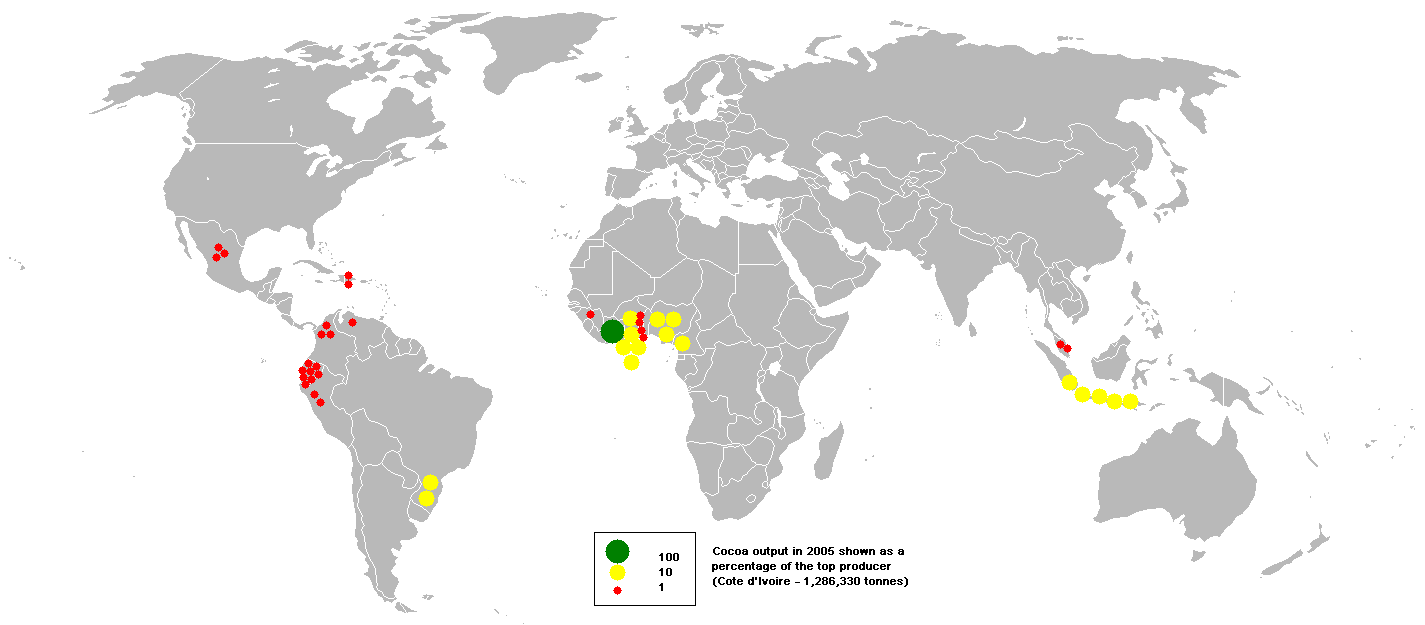
Above is a map detailing cacao output around the
world. Notice the concentration in equatorial climates. My good friends over at
Wikipedia confirm this -- “Cacao
trees will grow in a limited geographical zone, of approximately 20 degrees to
the north and south of the Equator. Nearly 70% of the world crop is grown in
West Africa.” [source]
The Royal Botanic Gardens at Kew
inform us “In its natural habitat, cocoa grows in the understory of evergreen
tropical rainforest. It often grows in clumps along river banks, where the
roots may be flooded for long periods of the year. Cocoa grows at low
elevations, usually below 300 metres above sea level, in areas with 1,000 to
3,000 mm rainfall per year.” [source]
Karen Wynn Fonstad’s Atlas of Middle Earth has several maps pertaining to vegetation, climate and season conditions
in Middle Earth. Based on the pieces of information she gathered from what one
hopes to be a close reading of Tolkien’s work, she suggests that Gondor, the southernmost
region Tolkien’s work touches on in any detail, has mild winters and hot, dry
summers, similar to the climate of the Mediterranean and Southern California. She
also suggests that further south of Gondor, in Harad, is arid grassland, similar
to what one might find in the Great Plains region or in Central Asia.
Nowhere in her maps is any mention
made of rainforest, or of a climate with a rainfall level significant enough to
support a rainforest. (Those would make really cool Ents, though, don’t you
think?)Wednesday, July 17, 2013
Moving Out, and other 'Emerging Adult' Life Choice Quandries
 |
| A room with a view or a room of one's own, it's all the same to me... |
Yesterday at lunchtime I sat, by myself, in the heat of a Midwest afternoon, and contemplated selfishness, fiscal responsibility, and moving out of my parent’s house. Not necessarily in that order.
Yes, I am one of those recently graduated twenty somethings
still living in my parent’s basement. (Yes, I am actually in the basement.) I’m not complaining – I love my parents
and they’re very easy to get along with. In fact, I rather enjoy living at
home. I’m not contemplating this move because of anything anyone said or did,
or didn’t say or do. I’m doing it because I’m afraid I’m lazy, because I’m too
comfortable, and that if I don’t do it now, I won’t do it at all.
I’m a member of that generation that the phrase ‘emerging
adulthood’ was built for. We graduated with degrees in things we liked and
moved back home to cower underneath a
lot of student loan debt. Some of us had helicopter parents. Most of us grew up
with internet connections in our homes and technology to help us around every
corner. We’ve been called entitled, lazy, vain, and overeager for our quick fix
of self-esteem boosting. People write all kinds of articles about us telling
how we’ll be the downfall of civilization or just a new chapter in human
history or points in between. (You can read articles here
from Time, here
from the New York Times, and here
from USA Today).
It’s hard to be an ‘emerging adult’ and not take some of
this to heart. As someone who grew up listening to everyone talk about twenty
somethings and credit card debt and the housing crisis and student loans, I
feel like a pretty financially responsible person – I pay more than my student
loan lender asks me every month (part of my evil plan to pay back my loan
early) I have a pretty healthy trio of savings accounts that get regular
deposits, I don’t use my credit card except to buy plane tickets, my new job
allowed me to start a 401(k) that gets 3% of my paychecks, I almost can’t bring
myself to shop in regular retail stores after thrifting for so long, and I
always consider what the cheapest thing is at Starbucks before I take myself
out for coffee, which only happens once in a blue moon anyway, because from my
side of the tracks a Starbucks habit sounds like the first step on the road to
ruin.
And I don’t want to consider myself a mooch, either. In high
school, I had no part time job, no money, and no car. I ended up getting a lot
of help from a lot of people that I couldn’t necessarily pay back. Oh, you’re ordering in pizza and everyone
has to pay their share? Someone had better pick up Merc’s five dollars. When
I got to senior year, my parents not only bought me a car so I could get to my student
teaching gig but also started giving me what amounted to a stipend ($75 dollars
every two weeks to make sure you eat and keep gas in the car we bought you.)
As I quickly discovered, $150 dollars a month can go a long
way towards keeping a car in gas and paying for groceries for just one person if you play your cards right.
I learned to love my crockpot, and I made sure that every time I had something,
I shared it. Oh, we’re having a birthday party for someone on the floor? Let me
bake you cookies. Pizza on Friday night? In reparations for years of other people
paying for mine, let me pick up the bill. You just invited me out for frozen yogurt? I have a coupon, and in the interest of making things easy for the cashier, let me get this.
My grandmother, who is one of the most generous people I
know, explained to me once that the reason she is so open-handed with her
grandchildren is because she never got anything from her grandparents (who were
emotionally distant as well). She wanted to be the exact opposite for her
grandchildren, and she is, and that’s the kind of person I’ve striven to be, in
college and after. Generous, but not to the point of exceeding my income.
But now I’m back at home, and thrift and economy aside, I’m
starting to feel like a mooch again. I pay my share of the car insurance, fill
my own tank and pay for my own oil changes, I contribute to the communal
cupboard once in a while, I do the dishes and any other chores when I’m asked,
and I participate without complaining in the yardwork. And I know that whatever
evidence there is to the contrary, I’m still a burden on my parents.
Which is why I’d like to move out.
My younger brother, who next year is starting his sophomore
year at college, just signed a lease (with mom and dad’s help) on an apartment.
He commuted to school last year to save money, and now he’d like to live closer
to school and have a normal college student social life that doesn’t involve
two trains and a bus trip. I get that. But my brother is also significantly more
independently minded than me, and I’m worried, as the oldest and a bit of a
homebody, that my staying at home is setting a bad example. (It also doesn’t help that my other brother,
who is also younger than I am, asks every couple of months when I am getting my
master’s degree and when I am moving.)
I’ve been at home for two years since graduation. I have a
full time job now. Why shouldn’t I strike out on my own? Isn't that what Virginia Woolf alluded to when she said "A woman must have money and a room of her own if she is to write fiction"?
I put this suggestion to my parents, listed off several
apartments I’d seen on craigslist, talked about how I’d run the numbers and
thought I could make it work.
My mother shrugged and my father said no. “I want you to be
financially stable when you move out,” he said, citing something about owning
your own car and being able to put a downpayment on another when the old one
goes and being able to afford a house. He’d spoken with a co-worker of his who
owns shares in several apartment complexes as a side business. When this co-worker
was younger, his grandfather had given him the same advice about owning and not
renting, and he didn’t take it until several years later. Renting is a black
hole for money that doesn’t pay you back. But buying a two-flat living in one
half and renting out the other, that is the way to go.
Where do they even have
two flats? And when will I be able to afford one of those? And if I save
a little every month for the long-awaited for house, can’t I have my own front
door right now? Surely a little 600 square foot studio that I can bicycle to
work from isn’t too much to strive for. My grandparents also keep asking me why
they haven’t met a boyfriend yet. There’s not a whole lot that sounds more
derpy to a potential date than ‘Sorry, no, not my place, I live with my
parents.’
I rustled up a list of potential apartments anyway, sat down
at lunch to call them – and then felt incredibly guilty about it. Am I only doing this because all my friends have their own apartments and I'm embarassed to say, "Here, come over to my house. My parents might join us for dinner"? Was I being
selfish for wanting my own front door and forks and a rice cooker and a washer
and dryer and a place to bring my friends on Friday nights? I’d be buying more things just to furnish the place, and that’s a little materialistic. Am I only doing this because I want more stuff? The energy use of a
small apartment like that would be more than if I was living at home – lights
to keep on, dinner to cook. Just the other day, in light of six family members needing to be six different
places with only four cars, my dad had dropped me off at work and taken my car.
They couldn’t do that if I didn’t live with them and didn’t give them the
flexibility of that extra vehicle. Living in community means that you save on
things like energy use (if five people are all in one room they can use the
same lights) and cooking dinner and yes, driving to work every day.
And it would be lonely, being just me. Living in community means just that -- community.
So, friends, I am putting this question out for you. What are
your thoughts, your feelings, your experiences with moving out?
Monday, July 15, 2013
Hello! (This Musical Won't Change Your Life!) Thoughts on the Book of Mormon
Friends! How go things with you?
Life has, of late, not left a whole lot of brain power for
writing, so posts have been necessarily sporadic. But last week my good friend
Artemis (she of the Thor/Loki/Fandom conversation) asked me to come along with
her to see Book of Mormon, and after we’d discussed it a long while on the way
back to the train station, she said, “So, you do realize you have to write a
blog post on this now, don’t you?”
Well, she did pay for my ticket, so yes, I do have to write
a blog post on it now.
Let me preface this by saying that Book of Mormon is not a
musical I would have elected to go see by myself. I’m not a fan of South Park
or the particular brand of humor on that show, and I’m not really crazy about
Mormons, and I’m really, really
not a fan of making fun of anyone’s religion. Pretty much I was going because I
had the next day off and my friend had a ticket. So I went.
And, surprisingly, I kind of enjoyed myself. For those of you who, like myself, have not
been bothered with Book of Mormon, let me give you a summary.
The musical opens with a class full of eager young Mormons
who are finishing up their missionary formation and going to do their required
two years of missionary service. (As an aside, this is pretty much the only
song in the show I absolutely loved. Here, let’s listen.)
We meet Elder Price, who’s kind of the ‘spit shined shoes,
gets everything right, teacher’s pet’ type, and Elder Cunningham, who’s kind
of…not that type. Elder Price is really hoping he gets assigned to his dream
post, Orlando, Florida, and Elder Cunningham is just excited that he gets to go
somewhere and maybe make a friend. As you’ve probably guessed, for the
requisite comic element, these two characters get paired together to do their
missionary service in Uganda, which Elder Price is less than thrilled about.
The audience sees the families of these two young men saying goodbye at the
airport, giving some sense of how they turned out the way they did, and then,
after some clever scene changes and less than memorable songs, they arrive in
Uganda.
There’s a very famous piece of writing often taught in Post
Colonial Literature classes called “How
to Write About Africa” by Binyavanga Wainaina, in which Wainaina points out
all of the accepted tropes or stereotypes western authors use to talk about
Africa. (One of those tropes being that you can always just talk about Africa
as a big mass, because, as all men of learning know, Africa has no internal
distinctions, cultural boundaries, or ‘difference’ to distinguish one part of the continent from
another. ) (Please pardon my sarcasm.) If you’ve never read it, it’s a really
great piece of writing, and very relevant here because that’s what Uganda is in
this play. The scene opens and it’s all there – the dung huts, the sad people
milling about in the streets, the requisite warlord who’s terrorizing the villagers
and stealing the luggage of well meaning white missionaries. It’s a bit of dead
horse – which is a little funny, because in a bit of clever visual punnery,
there actually is someone dragging a dead horse across the stage.
I’m not sure if this is okay, but when the curtain came up
on this scene, I frowned. The villagers started singing and making jokes about
how they have maggots in places I don’t want to think about, and I felt like I
was watching some kind of post-colonial train wreck. Which I expressed to
Artemis during the intermission. “What if,” she said, “the way that the set is
done is supposed to convey how Price and Cunningham see and perceive Africa?”
We agreed that both men set themselves up to think that the place they’ll be
going will terrible – and lo and behold, it is. I think that’s pretty fair. We
find what we expect to find. (Does that mean I expected to find stereotyped
Africa in the play? Food for thought.)
After arriving in the village, Price and Cunningham learn
that (as we might predict) the mission has been unsuccessful thus far. It’s
hard to sell religion to people who can’t get their basic needs met every day. Price,
being the goody-two-shoes that he is, decides to take matters into his own
hands – and gets nowhere, until he and Cunningham meet up with the village leader’s
daughter, Nabalungi. (It’s a reoccurring joke that Cunningham, who thinks she’s
really cute, also can’t remember her name.) Nabalungi, unlike the rest of the
villagers, is really sold on what Cunningham and Price are talking about when
they talk about paradise.
But somewhere their wires have crossed. Price is talking about the heavenly paradise
after death – Nabalungi is convinced that if they convert to Mormonism, they’ll
be granted access to Salt Lake City, which sounds like a paradise to her. “My
mother once told me of a place/ … I always thought she'd made it up/To comfort
me in times of pain/But now I know that place is real/Now I know it's name/Sal
Tlay Ka Siti/Not just a story Momma told/But a village in Utah/Where the roofs
are thatched with gold.”
Ah, gold roofs. A staple in the dreams of every immigration
narrative. And it gets better!
“They have vitamin injections by the case” “The warlords
there are friendly/They help you cross the street/And there's a Red Cross on
every corner/With all the flour you can eat.”
With a paradise like that, it’s not difficult to see why the
missionaries aren’t getting anywhere. These are folks who are really down on
their luck. (Wainaina would probably have something to say about that, too, but
we won’t go into that now.)
Now, this is where the story gets interesting. Price gives
up, but Cunningham, who wants really, really badly for his friend to stay and
not get reassigned to Orlando, decides to give the missionary work another go.
He starts reading from the Book of Mormon to the villagers – and when they stop
paying attention, Cunningham starts adding a heavy gilt of pop culture
references, action, and drama. That seems to work – but they still don’t
understand how this ‘book about America a long long time ago’ can help them
here in Uganda. So Cunningham does what any stressed-out teenager does – he
lies. He starts adding elements into the story that make the Book into a
document that applies to the villagers’ lives. Of COURSE there’s something in
the Book of Mormon about struggling with AIDS and dysentery and warlords and
your daughters being raped!
But it works – people start converting. The lying and pop
culture references, of course, get Cunningham in a ton of trouble when the
Mission Elders want to come and see how the mission is doing and get treated to
a dramatic interpretation of Cunningham’s new and improved Book of Mormon.
(Which I was also kind of not okay with for lots of reasons, but I’m weird, so
we’ll ignore that and move on.)
Having found out that everything she’s been told about god
and paradise is a lie, and that converting to Mormonism doesn’t mean she gets
to go to Salt Lake City, Nabalungi tries to run away. The villagers, however,
try to talk her back into a good relationship with God. She tries to explain
that everything Cunningham’s told them is made up, that it never happened, and
that subsequently, it doesn’t mean anything.
“Of course -- it’s a metaphor!” the villagers exclaim.
“Prophets always speak in metaphors. You don’t actually think Joseph Smith
fucked a frog, do you?” Duh! What do you think we are, ignorant or something?
(Frog fucking was one of those elements Cunningham added in
for cultural relevancy, as a helpful alternative to fucking virgins to cure
AIDS, and it gets brought up a lot. I guess I just don’t like humor that relies
on sex jokes.)
I think what saves
this from being a total post-colonial train wreck is the fact that there are
some points in the play where the villagers really take a stick to the eye of the missionaries and
point out that their missionary work (which is pretty much limited to ‘Here,
let us give you this book, accept Jesus as your
lord and savior’) is really useless, especially when you have to worry
about things like your daughter getting raped by the militia or where your next
meal is coming from or whether the nearby river will flood your house and take
away all your possessions and arable farmland.
And the moment described above, for me, saved the whole musical.
The smartest line in the whole production is spoken by one of the villagers,
the villagers whom everyone has assumed know nothing about the world and the
way the world works. They’re not dumb – they know a great deal. They just don’t
have the resources or agency to do anything with that knowledge. Until
Cunningham wakes up some of that agency with his storytelling. If the people he
talks about in his version can stand up against their evil warlords or live with
dysentery, why can’t you? What Cunningham has done with his reimagined Book of
Mormon is what many great preachers do every Sunday – he made it relevant to
his audience. (His methods might be a little questionable, but he did it with
good intentions.)
And that brings me to the real point of this blog post, the
‘take’ that Artemis wanted from me. I’m one of the only really religious people
Artemis knows. (I'm more culturally Catholic than what I can in good conscience label authentic Catholic, but the point still stands.) She and I were watching the same show with two different
agendas, and she wanted to know how my religious agenda had taken in and interpreted all of this.
One of the things that struck me throughout the play was the
missionary work itself. As the play points out, just talking to people about
Jesus isn’t very helpful. (Duh.) However, a doctrine of works, as some theologians
have termed it, is much closer to what Jesus advocates for in the new
testament. (This
Sunday’s gospel reading from Luke was the story of the Good Samaritan –a doctrine
of works reading if ever there was one.) Now, we could talk A LOT about how ‘good
works’ can go really, really wrong in lots of ways, but essentially, the idea
of doing good works comes down to religion being practical and supporting the
practical, day-to-day needs of the community. Cunningham did this by addressing
his ‘scriptures’ to the problems the community faced everyday, giving them
hopeful stories that would support them as they went about their work.
The other thing that struck me was the play’s message about
the authenticity of religion and religious practice. We’re given two
characters: Elder Price, who does everything by the book and would be a perfect
religious example except that he’s only doing these things in the hope of an
earthly reward, and Elder Cunningham, who hasn’t even read the book, is unaware
of basic dogma, and yet genuinely wants to help people by sharing the feeling
of solace he gets from his God. Both of these religious practices are wrong, to
a certain degree, and both could stand to have a little more of what the other
has. Blind, unquestioned faith is just as harmful as no faith at all, and the
Christian God also says that you should live and work for the betterment of others, not just for
yourself.
So, to summarize, the Book of Mormon wasn’t a waste of time,
but some of the humor was probably wasted on me. I can, however, appreciate a
story that promotes a little bit of dialogue, which this show did on a variety of different subjects, and for
that, I can say that if you're going, you'll at least have something to talk about afterwards.
Thursday, April 25, 2013
This is a post about Fan Identity. And Friendship. And the Upcoming Thor Movie. (But mostly about Friendship.)
I’m now on week four of my new job, and things are going splendidly
(For those of you who don’t know, four weeks ago I transitioned to a full time
job in visitor services at a local arboretum.) I took a walk at lunch time
yesterday and, walking through a stand of really magnificent conifers, realized
“They actually PAY ME to show up here every day!” It was a really good
realization that I need to make more often, because I've been a little down lately.
Don’t get me wrong – my new co-workers are lovely, lovely people.
But I’m easily the youngest person on staff by twenty years and as such, I have
a different sensibility about the way the world works and a totally different
view on pop culture.
As I put it to my friend the other day, there is a large nerd-shaped
hole in my work life.
At both of my other jobs, I had people I could
talk to about movies and books and sci-fi things, and make Star Trek jokes, and
that was awesome. Now I’m still trying to figure out if anyone will understand my
Star Trek jokes, let alone laugh at them.
Put
it this way: I didn't know I liked being able to publicly identify as a nerd
and with other nerds/geeks/fans until that identification didn't make a
connection with people.
I
think my more recent involvement in Tumblr has something to do with this as
well – on tumblr, everyone is all fandom all the time. They’re excited to share
things they make and find, and I love that enthusiasm.
I also like to share and ‘real life reblog’ with
WILD abandon. We have a board at work where we can write what wildlife we've seen,
and you have no idea how excited I get
when I see a new bird and I have something to write on the board. I do this
with birds, with books I've read, movies I've seen, and especially movies I
want to see.
Except
now I have no one to reblog to.
Well,
the temporary solution to this problem is going to be dinner after work with my
good friend, former co-worker and all-around lovely person on Friday. For the
purposes of this blog post and the internet, we’ll call her Artemis. Last
night, in planning for said dinner, we talked about a number of museum things
(I consider her someone I can talk about professional development stuff with) and then I said we should make time to see the
new Thor movie (we initially bonded over the Avengers films.)
She
said this was a GREAT idea, and then she asked a rather interesting question. “Is
it bad that I’m more excited to see Loki rather than any other character in
that movie?”
I
assured her I did not think this was bad in the slightest, and observed that there's
a whole HUGE group of people on the internet who fangirl Loki like it's not
cool to fangirl Thor.
Please
don’t mistake me, I think Loki is a fascinating character, both in the
mythological sense and in the Marvel sense. I just can’t get my head around supporting the
embodiment of mischief. My personal mythological fangirlyness has always been
directed at Tyr, the son of Odin who loses his hand fighting Fenrir and who is
supposed to be the embodiment of the valor befitting warriors. The mythological
Thor seemed a little mainstream. And so, it seems, is the Marvel Thor
considered a little mainstream.
“It’s
the bad boy thing,” Artemis explained. “Girls have this inner need to take care
of or help the "lost, dark soul" kind of guy. Thor, on the other hand,
is a jock type.”
I
agree with this statement. In real life, we often have very little patience for
jock types whose confidence and braggadocio can be overwhelming, especially for
people who have never had confidence like that. Loki as a character is much
more accessible. Particularly in the first movie, where so much of his story
line is about trying to find himself. Thor in the first film is also trying to
find himself in the wake of loosing Mjolnir and being kicked out of Asgard, but
not to the same extent that Loki is. For
fans, and I think particularly for the young women to whom a tortured, dark
soul appeals, his story is one they see
reflected in their own lives, where they too are searching for meaning and
identity. One of the places they find
their identity is in their fandoms, which leads me back to the issue of identity
that I was having, and that Artemis was fulfilling for me with this
conversation, and that I am now fulfilling with this blog post.
Anyway.
“Also,”
Artemis went on, “A TON of fangirls ship Loki/Thor, which is interesting.”
What
do you know, another part of fan identity! I commented that, at least in my fan
practice, fangirls as a general rule tend to ship M/M ships. There's actually a
considerable body of research on why that I couldn’t get into during the course
of our conversation, but some psychologists and media studies folks think this
is because many young female fans are at a point in their lives where they may
feel threatened or intimidated by the thought of romantic involvement, and
therefore writing a relationship that they don’t need to see themselves inside
can be grounding. Other media studies folks explain that M/M shipping is a way
to rebel or talk back against heteronorming inside mainstream media, which also
appeals to teenagers who are trying to explore their sexuality.
Whatever
the case may be, I have never considered myself one of those fans. From day one
inside the fandom, if I was going to be a fan of a male character, I was also
going to write myself (or a better, prettier, much more interesting version of myself)
into the story, there was going to be lots of really fabulous, M/F sexual encounters,
and that was going to be that. (I have a
pretty stable, boring, mainstream gender identity – probably more information
than you wanted to know.)
“Another part of my issue,” she explained, “is
that there are so few well written OCs (male or female) so even when a
character is clearly straight [inside the text] it can be easier to see an
emotional connection between them and another male rather than a poorly written
female OC.”
Now,
that I whole-heartedly agree with. OCs are a sticky wicket. But the reason for
me writing those characters is also one of the reason I think M/M shipping
occurs at the level it does-- because there is a general dearth of female
characters inside many mainstream fandoms.
It's simply easier to make an M/M friendship into something more than pairing
them with an existing female character, or trying to write a believable original
female character, or OC. As a reader, I
want a place to see myself inside the text, which is why I strongly champion,
or flat out make up, more female characters. (In general, I think I've been
pretty good at writing OCs in the past, and I haven’t gotten too many
complaints about them so far.)
“I
can support any ship there is evidence for,” Artemis went on. “That people who just
throw two characters together who never interact or have any chemistry is a
little annoying.” This much I think we can all agree on. “But with the
Thor/Loki, I'm the fence, because if you looked at it from the right angle,
there could be underlying emotion going on. Even more so when you add in the
deleted scenes from the movie.”
I
get that. That makes sense to me. The Sherlock/John ship makes sense to me. The
Frodo/Sam ship makes sense to me. Heck, even the Kirk/Spock ship makes sense to
me. I’m not hating on valid and wonderfully close readings and interpretations
of our fan texts. I think that’s great, and as I've gotten older, I've given
these ships more credit than I had in the past because I see the close reading
that goes into legitimizing those relationships, and I am in awe of some of it.
(I just don’t want your Fili/Kili slash on my dashboard. Sorry. Brothers are
different.)
But,
as I explained to Artemis, another part of me gets kind of angry because I feel
like shipping for some of those reasons almost de-values deep friendships
between males, like they can't happen without having a romantic root. And I
don't think that's fair to men. Not just fictional men, not just John and
Sherlock, not just Frodo and Sam – all men. When two female characters have a
close friendship, I don’t see the same kind of F/F shipping sprouting up that I
see when two men do, just as in real life two women can get away with being
much, much closer than two men seem to be able to without people reading the relationship
as something that it isn't.
And I really don’t think that’s fair.
I
wish I had someplace interesting and concrete to go with all of this, but I don’t.
I suppose the point I could be making is that identity, especially fan identity, is
important to all of us, we should find it where we can, hold up and defend the
personally chosen identities of others, and strive, always, to incorporate them
and the values they stand for into our real lives as well.
Whatever it is, Artemis is coming over for dinner tomorrow night, and we
shall make a good night of it and be fans together.
Thursday, April 18, 2013
Poem: To The Rainstorm Disturbing My Sleep
3 a.m. rainstorms, we have to stop meeting like this.
The first time,
when you woke me up with lightning in your dancing eyes,
I thought, What's one night of sleep, more or less?
when you woke me up with lightning in your dancing eyes,
I thought, What's one night of sleep, more or less?
It was a forbidden-fruit kind of fun,
lying in my bed while the rest of the world was sleeping,
and thinking deep thoughts as you drummed your fingers against the window
and sang me little songs and made me forget about
everything except you.
lying in my bed while the rest of the world was sleeping,
and thinking deep thoughts as you drummed your fingers against the window
and sang me little songs and made me forget about
everything except you.
We were a little island in the night, just you and I.
I was warm and safe and my poet’s soul never second guessed myself.
(Until that afternoon, when I had to own to all the yawning.
Because what's one night of sleep, between
lovers?)
But the second time?
The second time, when you raged outside my house
and hammered your fists against my front door
and threatened to tear the roof off if I didn’t
pay attention to you,
talk with you,
dance with you,
love you,
and I spent too many sleepless hours
trying not to let you in, until the dawn and the wind (dear neighbors) frightened you off for me?
and hammered your fists against my front door
and threatened to tear the roof off if I didn’t
pay attention to you,
talk with you,
dance with you,
love you,
and I spent too many sleepless hours
trying not to let you in, until the dawn and the wind (dear neighbors) frightened you off for me?
Then I regretted letting you in that first time.
No, 3 a.m. rainstorm, we can't meet like this anymore.
I'm in a healthy, committed relationship with my 6 a.m.
alarm,
and I'm not going to break up something like that
for a little hidden pleasure with a rainstorm on the side.
and I'm not going to break up something like that
for a little hidden pleasure with a rainstorm on the side.
Wednesday, February 27, 2013
Period Preparatory -- a poem.
It’s strange
that after three weeks of answering 8 o’clock phone calls thinking
that after three weeks of answering 8 o’clock phone calls thinking
This will be it
and the one that is it
is preceeded only by another murmur of indignation thinking
Who on earth calls at
8 o'clock at night?
3 weeks of thinking every 8 o'clock call will be the one
announcing that we need to
stop our clocks
cover our mirrors
and
bring out the black crepe to blot our eyes.
and the one call does not do any of these things.
stop our clocks
cover our mirrors
and
bring out the black crepe to blot our eyes.
and the one call does not do any of these things.
we do not stop the clocks or cover the mirrors.
The black crepe does not make an appearance, nor do the floods of tears.
My mother goes back to work
My father turns on the television
And me?
My father turns on the television
And me?
I
f l o a t,
an untethered balloon,
afraid that to do anything other than mourn will mean
that she was a trivial thing,
that I did not love her.
I have been answering 8 o’clock calls for three weeks,
for a month and a half,
since before Christmas,
since forever,
thinking
This will be it.
f l o a t,
an untethered balloon,
afraid that to do anything other than mourn will mean
that she was a trivial thing,
that I did not love her.
I have been answering 8 o’clock calls for three weeks,
for a month and a half,
since before Christmas,
since forever,
thinking
This will be it.
And this is it.
And I find I have no tears to cry.
And I find I have no tears to cry.
Only a kind of small hole in my heart,
as though all the tears
have already leaked out in preparation.
as though all the tears
have already leaked out in preparation.
---
My great-aunt died yesterday. I didn't really know what to do with myself. She'd been suffering for a long time, and death was kind of for the best at this point. I still didn't know what to do with myself.
So I wrote a poem.
A "Period Preparatory" is a time frame before something else happens -- the phrase as it is seen here is usually "Period Preparatory to War" a pre-mobilization phase of planning and readiness.
Friday, February 15, 2013
Prayer for the Beginning of Lent
When you ask me today,
Friend, what are you doing?
I will tell you,
I am building the inner room.
I am letting the inner room build me.
I am constructing a place for the spirit of God to dwell.
I am letting the inner room build me.
I am constructing a place for the spirit of God to dwell.
You will say to me, Friend, show me the place!
For I wish to labor there also. Show me the hillside, that I may find it pleasing to my Lord,
For I wish to labor there also. Show me the hillside, that I may find it pleasing to my Lord,
and I will tell you,
I am building a room without walls – I am building a house
without beams to hold it.
I have taken my ribs for walls, and my spine will be the ridgeline of the roof.
My eyes will be its windows, and the roof of my mouth the lintel posts.
I have taken my ribs for walls, and my spine will be the ridgeline of the roof.
My eyes will be its windows, and the roof of my mouth the lintel posts.
Oh, my beloved friend, if I could admit you!
If I could show you truly the dwelling place of God within me. For it is my wellspring and my delight,
It is a place truly pleasing to me,
And I would share it with you always.
If I could show you truly the dwelling place of God within me. For it is my wellspring and my delight,
It is a place truly pleasing to me,
And I would share it with you always.
Let my words go in and out from my doorways into yours,
Like friends moving between our two houses
and in that way your place will be known to mine
and mine to yours.
Like friends moving between our two houses
and in that way your place will be known to mine
and mine to yours.
----
One of my goals for Lent this year is to do a little bit of spiritual reading once or twice a week, and I decided to start that I'd go to Mass today. It ended up being a little bit more emotional than I bargained for (think me and crying and looking ridiculous over nothing except being in church reading) and, of course, when I get emotional, I write. I wrote part of this on the way home.
I figured out I really, really like being able to visit other people's inner rooms, as they're described in the poem. If you want to talk about God, I'm listening. My inner room is open to you.
Thursday, February 7, 2013
Green Eyed Monsters
One of my online acquaintances posted a new chapter for her story today.
I haven't read it yet, but the rest of her work is amazing, and I'm watching her reach out to all of these people on tumblr who love her story and I'm feeling so very, very low, that this story that I've worked on for nearly four years only gets four or five reviews a chapter and there is no fanfare and no one leaps up rejoicing when I post something new.
I'm tired of working on old, tired things that don't bring me any joy and don't seem to bring anyone else much of any joy, either.
I have a green-eyed monster rumbling in my chest, and I don't like it.
I wanted to go outside to shovel my driveway and take my mind off of things, but the driveway's not even covered, really, and the snow is slushy and wet and doesn't shovel well, and it didn't help much take my mind off of anything.
I want fanfare for something in my life. I want to be good at something -- I mean, really good at something -- and get more than a pat on the head for it.
I want to stop feeling useless and stuck and move forward with something.
I want someone to care.
I haven't read it yet, but the rest of her work is amazing, and I'm watching her reach out to all of these people on tumblr who love her story and I'm feeling so very, very low, that this story that I've worked on for nearly four years only gets four or five reviews a chapter and there is no fanfare and no one leaps up rejoicing when I post something new.
I'm tired of working on old, tired things that don't bring me any joy and don't seem to bring anyone else much of any joy, either.
I have a green-eyed monster rumbling in my chest, and I don't like it.
I wanted to go outside to shovel my driveway and take my mind off of things, but the driveway's not even covered, really, and the snow is slushy and wet and doesn't shovel well, and it didn't help much take my mind off of anything.
I want fanfare for something in my life. I want to be good at something -- I mean, really good at something -- and get more than a pat on the head for it.
I want to stop feeling useless and stuck and move forward with something.
I want someone to care.
Saturday, January 26, 2013
Gems of Erebor: The Case for Dwarf Women In Tolkien-Based Fanfiction
Since seeing The Hobbit a few days ago with my sister, I’ve had dwarves on the brain.
Yeah, I know, you’re all rolling your eyes and sighing, Oh, dear, Mercury joined the Thorin Oakenshield bandwagon, and it’s true. I admit it freely and gladly. Before seeing the Hobbit, I wouldn’t have given the occupants of the Iron Hills a second chance. Now, I’m reconsidering that position. I re-read The Hobbit, twice, and I’m working my way through Lord of The Rings again, and I’m reading a lot of fanfiction.
Oh, dear. Fanfiction.
Now, as the fanfiction around the Hobbit has picked up steam, we’ve started to see the same trends that long-time readers of LOTR fanfiction have seen– the movement towards writing Original Characters in a (mostly) highly unbelievable style, the trope known in fanfiction as the Mary Sue. What’s interesting to me is that many of these Sues, like those in the LOTR canon before them, are all elves, Men, and Hobbits. There are very few dwarf women written about in fanfiction.
This doesn’t make a lot of sense for a lot of reasons, chief among which is that elves and dwarves don’t get along. At all. Ever. The Battle of the Five Armies was pushing it. No matter how well written your character, the fact that she’s an elf, or a half-elf half human, or an elf who was raised with dwarves, it will not make sense inside Tolkien’s canon, movie or otherwise. (Not until the late Third Age and the friendship of Gimli and Legolas. But that is noted as being extremely out of character for the both of their races.)
Ladies, hear me out here. I know that your OCs are wish-fulfillment. We’ve all been conditioned to think that the way the elves look and the way the women of the Dunedain look is ‘normal’ and ‘beautiful’. I get that. Most of my favorite LOTR characters are females of Numenorean descent. I’ve got a whole story filled with females of Numenorean descent, and I love them all dearly. We’ve also been conditioned to think that Dwarf females are different. Like, waaay different. Like, the punchline of jokes different. And that scares us, because it makes us and our OCs vulnerable.
Yeah, like that. Laugh it up, Gimli.
And the more I thought about it, and read about it, and researched about it, the more I started asking myself, what’s wrong with being a female dwarf? In fact, who wouldn’t want their character to be a female dwarf? Because female dwarves have some really awesome stuff going for them.
1) Dwarf beauty, male and female, runs on a totally different level.
Writing about the beauty of dwarves can be a new challenge for a writer, and an exciting one at that -- they’re not a race that Tolkien spends a lot of time on, and so their standards of dress and beauty can be something totally outside of what we consider ‘normal’. This can be very liberating – you can make up whatever you want to! Several fan artists have explored this concept with dwarf beards (or lack thereof) and female facial/body hair. Now, some people will argue with me that most of the other races of middle earth would consider dwarves ugly, and the idea of being mistaken for a dwarf man is not an appealing one. Fair point – not all dwarf men can look like Thorin Sexyshield. But – and this is a big but – what if the reason that dwarf women are seldom seen in the rest of the world, and when they are they’re mistaken for dwarf men, is because they are so terrifyingly beautiful they have to disguise themselves out among the other peoples? Also, if dwarf beauty is different, then dwarves will find different things beautiful. Not a problem at all.
2) The dwarves have a love of craft, and practice is open to both genders.
Since the beginning of time, when they were fashioned by Aule, the heavenly smith, they have loved to build and make beautiful things out of the precious stones in the earth, and they admire those who can do this well. In fact, they believe that at the End of Days it will be the task of the Dwarves to help re-build Arda. If women among them are few, and those few women can easily pass as men in the world outside the dwarf cities, it seems to me that both men and women can gain great skill in their chosen craft, be it smithing or carving, and be appreciated and well-noted for it. Not only do they carve stone and shape metal with great skill, but they are also tremendous singers and writers of songs, as well as makers of instruments – when Thorin and Company show up on Bilbo’s doorstep, they also bring with three flutes, two fiddles, a drum, two clarinets, two bass viols, and Thorin’s great golden harp ( Hobbit 26). (Recall also when they finally do come to the Mountain, they find that harps left silent for centuries are still in tune. (Hobbit 228))
3) There is very little emphasis in dwarf culture on family life.
Now, I am not saying here that there are no happy families among the Dwarves – I think that is very untrue. If what we see of the familial groups in the Company of Thorin is any indication, dwarves form very strong ties with their families – another attribute in their favor. My point here is that it is not the be-all and the end-all for dwarf women to marry. As previously discussed, it is perfectly acceptable among the dwarves to devote your life single-mindedly to the pursuit of your craft – one of the reasons the dwarf population doesn’t grow very quickly. Several authors, as well as Appendix A of the Lord of the Rings, allude to the fact that only a third of the dwarf population were women, and that part of the population didn’t feel the need to marry all the time. (Thorin, for instance, is noted not to have a wife.) Many of them found fulfillment in the perfection and recognition of their chosen art.
4) Dwarf love runs deep.
Tolkien always writes of them as a single minded kind of people; for instance, in the Silmarillion, when speaking of the creation of the dwarves, he writes “…Aule made the Dwarves strong to endure. Therefore they are stone-hard, stubborn, fast in friendship and in enmity, and they suffer hunger and hurt of body more hardily that all other speaking peoples…” (Silmarillion 44) It is because of this stubbornness that love and admiration among the dwarves can be a difficult thing – “Dwarves only take one husband or wife in their lifetime, and are jealous, as in all matters of their rights. The number of Dwarf-men that marry is actually less than a third, and not all the Dwarf-women take husbands either; some desire none, some want one they cannot have, and will have no other one. There are also many Dwarf-men that don't want a wife, because they are obsessed with their crafts.” (Tolkien Gateway). While this sounds a bit dire, it sounds a bit dire for both genders. If you fall in love with someone you can’t have – tough luck on both sides. Unlike the women of the races of Men, who tend to be stuck if they marry someone they don’t like or are barred from marrying someone they do, Dwarf women have the possibility of spurning romantic entanglements in favor of craft, or of finding solace in their work. On the reverse, if you do end up finding someone who loves you back, heaven help the rest of the world if they want to keep you apart.
5) They already don’t get written about often.
By my count, there are seven women of some importance in the Lord of the Rings. Three of them (Arwen, Eowyn, and Galadriel) have appearances in the book and made it to the movies, two of them (Goldberry and Ioreth) make appearances in the books but not the movies and two more (Gilraen, Aragorn’s mother, and Finduilas, Boromir’s mother) only get name-dropped but are still pretty crucial to the story. The Women of Middle Earth, in my opinion, need all the help they can get. But the dwarves have it even worse: only one dwarf woman is mentioned in all four books – Thorin’s sister, Dis. We don’t know anything about her except that she had two sons, and her status as the daughter of a king is enough to get her named in a genealogy table. But in my mind, that’s wonderful. We have no idea what dwarf women do or do not do! They can be warriors or smiths, songstresses or great miners. The sky (or perhaps the roof of the cavern) is the limit!
So, if you’re considering investing some time and effort in creating one of the beauties of Erebor, take a moment to read about the dwarves of Norse mythology, who are pretty closely tied to Tolkien’s dwarves. Find a really awesome Norse name for your leading lady and outfit her however you want to, with hospitable table and harp, or battle-horn and axe, and get out there and represent!
(And hey, if you're going to link to this somewhere else, or you've got a story to share, post it in the comments below.)
Wednesday, January 23, 2013
Prayer from Someone Failing At Her Job Search
Prayer from Someone Failing at her Job Search.
Aloud I cry to you, Lord God of the Universe,
Loud I cry, and listen for your voice.
For you will not abandon me, you will not desert me,
You and you alone will beside me in every hour of my need.
Oh, that I were Elisha in the temple, that I might hear you!
That I were a prophet of old, that I might know your way for
me!
I have sat in your temple and listened, and heard nothing –
I have sought you in the woods, and in the mountains, and
you have kept hidden from me.
I have lost the path, I have stumbled. There are rocks in my
way and I cannot move them.
You have sent wise council to speak to me – in their voices I
hear the beating wings of angels,
And in the echoes the temptations of the false prophets, and
of pride.
To them I cannot speak of my distress! You alone know it –
you alone will do right by me.
Would that the way were straightened, God, and the road
smooth, and easy to make out.
Would that I did not travel by night, and the Sun of your
goodness could guide me.
I am beset with evils – desperation sits at one shoulder,
and on the other is despair.
How am I to use the gifts you gave me, God? Who will hear
your handiwork in my words and in my deeds?
Aloud I cry to you, Lord God of the Universe,
Loud I cry, and listen for your voice.
--
So I was passed over --twice -- for another job today. I'm not sure what to make of this. I don't know whether to even continue trying to apply for jobs as an educator, despite everything everyone tells me about how well I teach or interact with visitors or anything else. Everything in my life right now seems to be saying that if I ever want to get anywhere in life (as in, out of my parents' house) I should just pack it in and get a real person job in Visitor Services or something.
I decided to take the experience and try and make something good from it, so I sat in my car for a good five minutes when I got home and prayed, and this is what came of it. The act of writing a prayer, as I think I've remarked before, is simply the act of praying the prayer, over and over, until it resonates the right way.
I was trying to figure out if I should tell my mother I didn't get the job a second time.
I'm still not sure.
Wednesday, January 2, 2013
Ships at Sea -- A Blog Post for the HMS Acasta
Over the past year, I've been fortunate enough to have not one, but two jobs doing what I love -- working in and around museums. And not just employed , but employed with a little bit of free time on the side to use for fun projects (Centennial Dress!), to develop and research my love of museums and living history and hopefully grow my practice as an educator.
I've started following a lot of really wonderful blogs this year -- blogs about costuming, about museum practice, and quite a few about living history. But there's one blog that absolutely blows my mind away every time they post something new.

The lovely gentlemen (well-deserved the word!) of The HMS Acasta take both living history and blogging to a new high. They make me want to live up to the appellation 'living historian.' It seems like every week they have well-thought out, beautifully executed content that not only advocates for their group and their work, but is also incredibly instructive and interesting. (They had me doing geometry several weeks ago. For fun. FOR REAL.)
Well, friends I am not much for naval math, although I did try and teach myself advanced geometry for a math project in college to understand navigation on a globe, which should give you some idea of how much I love reading about the Navy. I am also (unfortunately, in this case) not a male, which, geographic issues aside, rules me out from joining their reenactment group. But several weeks ago they announced a new project -- The Mail Packet. It is supposed to be a series of letters from their followers to various members of the crew.
Well, a male mathematician I may not be, but I can CERTAINLY be a letter-writer. I read several books on women and the Navy, lost myself in Persuasion for a day, contemplated my bookshelf of Hornblower novels and what Lady Barbara would do, and finally sat down to write.
So, without much further ado, my early 19th century self has written these fine gentlemen a letter. I leave it here.
Captain Freymann –
Your letters home have enjoyed a great deal of circulation around the neighborhood, and the general society hereabouts is quite in raptures at the skill of yourself and your crew in the varied arts of letter-writing. Your exercise with the flag-hoists was thought very clever -- such small perfect pictures! --even for those of us without a Popham’s close to hand, and the basic geometrics of navigation were enough to put even the most devoted of shore-bound mathematicians through their paces. One wonders how you gentlemen ever make it home with such instruments at your disposal! I suppose, like all other pursuits, it is one that requires a great deal of practice to perfect.
You must think me very forward to write this, being that I am of no particular relation to you. Suffice it to say that I am an admirer of general writing practice, and a firm supporter of the advancement of the art of naval warfare, and in both of these matters you and your crew have garnered my unstinting praise. Your own letters have been both instructive and entertaining, and I mean only to repay the compliment.
I imagine, in this season of the year in which so many family gatherings are the usual practice, that you and your crew must, feel a little longing to be at home. I cannot claim to have any especial knowledge of how the New Year is rung in at sea (though several estimable naval gentlemen of my acquaintance, Captains Wentworth and Aubrey, are attempting to rectify the matter) but I am sure that you must have some hint of merriment aboard.
There was some suggestion in this neighborhood of first-footing, but as fair-faced dark haired young men are thin on the ground in this part of the country at present, we have kept the old tradition here of waiting up for the first chime of the clock at midnight to let the old year out and the new year in, and that shall have to suffice. The chimes of our clock seem long indeed when the door is open – I fully wished the new year would hurry up and get inside before Papa and all the rest caught a chill! After we had waited out all twelve chimes, the door was shut tightly, all our luck for the new year locked in, and Mama’s punch liberally distributed to one and all for a toast. I imagine there was a little laughter and a good deal of singing that dreadful Scotch air after that, but I went to bed shortly after the punch. Did any of your young gentlemen stay up to bring the New Year in? I cannot see ships having front doors, but you must have a custom of some kind.
Today being rather cold, the cutting and fitting of a new dress will keep me inside – though I must endeavor to be quiet about it. It is near past ten, and most of the rest of the household has not yet risen – too much punch at last nights’ festivities, I should think. I shall not trouble you with the rest of the day's plans, as they are not likely to be of much interest to you, and my letter grows long without them. How I should hate to have you squinting over a crossed-over page for them! Let me then close. All the best of luck to you and your crew this season, or fair weather and plenty of prizes, however you should reckon it.
I am,
your humble neighbor,
Mariah Gray
For more about the tradition of firstfooting, traditional English New Year's Eve revels, the tradition of singing "that dreadful Scotch air", or the crossed-over letter, click through the links!
Tuesday, December 18, 2012
Centennial Dress Project -- The Fun Has Arrived!
One would think that graduating from college would give a person more time to do things like update their blog, but it has become apparent to me that real life takes it out of a body more than school life does. And two jobs does not time for dress projects leave. However, I think I can safely say that in three months (goodness me, three months!) I have made some pretty significant progress.
Item One:
I have purchased my patterns. (Huge hurdle to jump through).

Item Two:
I have purchased a large quantity of good muslin, and have made what amounts to one good muslin mock-up of my shirtwaist!
This also involved setting my first sleeve, which I was VERY proud of, since it turned out lovely. The second mock-up will be forthcoming in January when I actually have several days off.
Item Three:
My sewing table no longer has a hole in the middle where the original machine used to sit. It now has a lovely little door. Hip-hip-hooray for my father's carpentry skills!
Item Four:
I have met May.
Wait, you're asking yourselves, who on God's green earth is May and why is she so important that she gets bolded, italics, and underlines? Well, as I told you several months ago when I learned of May's existence, she's my new best friend And I finally got a chance to meet her.
Not in person, unfortunately, although I would have liked that a lot. May died in 1993 at the ripe old age of 96 years old. I got to met her through her letters, now housed at the Saint Benedict's Monastery Archives -- three years of correspondence that she sent to her mother and freinds at home between 1912, when she enrolled in Saint Benedict's Academy for one year of high school, through 1915, when she graduated from Saint Benedict's College as part of its first college graduating class with a degree in Music.
I got to read about her fears about being far away from home for the first time, about her despair that she would never be a good student (and then watch her grades climb to straight As by her last semester of college) and listen to her tell her mother about all her hijinks with the other girls in her class.
And oh boy, did those original Bennies get into some trouble sometimes. One of May's good friends, a girl named Denver McCloskey (Yes, I know, Denver! In 1912! I couldn't make this up! ) had "a kodak (sic)...and she's been taking pictures of different ones. Somehow the sisters always avoid having their picture taken." May goes into great detail about the various tricks the girls played trying to capture the nuns on film. She relates another hilarious story where, when a visiting dignitary was going to be shown the dormitories and one of her friends had stopped by to visit in her pajamas, the friend was shoved in the closet until the visit was over. She wrote home to tell her mother that she had bought her first piece of 'school swag', "One of the Saint Benedict's pillows. The colors are red and white," and, she adds with pride, "and I'm going to work it." ('Work it' as in, embroider over it even more, not 'work it' as in, show it off and be awesome with it. Although I'm sure she did that sometimes too. It may even be the pillow featured in this picture.)
She wrote about her freshman five (well, four and a half) with pride -- pride! -- when she wrote home to her mother after only a month at school and proudly declaimed that she was now 101 1/2 pounds. (At seventeen years old. Goodness me.)
To be quite brief, her letters were a wellspring of goodness and delight. I wished that I had known May -- I wished that I had gotten a chance to go to school with her. I wrote a poem memorializing my time spent abroad in Ireland to the great delight of the rest of the people on my trip. May did that, too, for all the girls in her graduating class. It was published in her yearbook. That was in her file, too. I might as well have been reading the letters of the 1912 equivalent of...well, of me.
And in the midst of all that, she took a solid page to tell her mother how she wanted her graduation dress to look. Riches!
I talked everyone's ear off about these letters after I got home from Minnesota. I couldn't quote them enough, reference them enough, rhapsodize about them enough. Now my parents think I should look into seeing what it takes to get letters published along with some sort of supplemental material for use in women's studies classes and the like. I think that would be a tremendously fun project.
But I still have to make a dress first.
Item One:
I have purchased my patterns. (Huge hurdle to jump through).

From left to right, they are : Saundra Ros Altman's Past Patterns # 403 Simple Edwardian Waist, Reconstructing History's Peplum Skirt, and Sense and Sensibility's 1914 Afternoon Dress.
Item Two:
I have purchased a large quantity of good muslin, and have made what amounts to one good muslin mock-up of my shirtwaist!
 |
| Historically correct garment in historically correct setting -- the Farmhouse. |
This also involved setting my first sleeve, which I was VERY proud of, since it turned out lovely. The second mock-up will be forthcoming in January when I actually have several days off.
Item Three:
My sewing table no longer has a hole in the middle where the original machine used to sit. It now has a lovely little door. Hip-hip-hooray for my father's carpentry skills!
Item Four:
I have met May.
Wait, you're asking yourselves, who on God's green earth is May and why is she so important that she gets bolded, italics, and underlines? Well, as I told you several months ago when I learned of May's existence, she's my new best friend And I finally got a chance to meet her.
Not in person, unfortunately, although I would have liked that a lot. May died in 1993 at the ripe old age of 96 years old. I got to met her through her letters, now housed at the Saint Benedict's Monastery Archives -- three years of correspondence that she sent to her mother and freinds at home between 1912, when she enrolled in Saint Benedict's Academy for one year of high school, through 1915, when she graduated from Saint Benedict's College as part of its first college graduating class with a degree in Music.
 |
| Internet, meet May. May, meet the Internet. They'll love you just as much as I do, I promise. |
I got to read about her fears about being far away from home for the first time, about her despair that she would never be a good student (and then watch her grades climb to straight As by her last semester of college) and listen to her tell her mother about all her hijinks with the other girls in her class.
 |
| Saint Ben's in 1913 -- so cool we had our own postcards. |
And oh boy, did those original Bennies get into some trouble sometimes. One of May's good friends, a girl named Denver McCloskey (Yes, I know, Denver! In 1912! I couldn't make this up! ) had "a kodak (sic)...and she's been taking pictures of different ones. Somehow the sisters always avoid having their picture taken." May goes into great detail about the various tricks the girls played trying to capture the nuns on film. She relates another hilarious story where, when a visiting dignitary was going to be shown the dormitories and one of her friends had stopped by to visit in her pajamas, the friend was shoved in the closet until the visit was over. She wrote home to tell her mother that she had bought her first piece of 'school swag', "One of the Saint Benedict's pillows. The colors are red and white," and, she adds with pride, "and I'm going to work it." ('Work it' as in, embroider over it even more, not 'work it' as in, show it off and be awesome with it. Although I'm sure she did that sometimes too. It may even be the pillow featured in this picture.)
She wrote about her freshman five (well, four and a half) with pride -- pride! -- when she wrote home to her mother after only a month at school and proudly declaimed that she was now 101 1/2 pounds. (At seventeen years old. Goodness me.)
To be quite brief, her letters were a wellspring of goodness and delight. I wished that I had known May -- I wished that I had gotten a chance to go to school with her. I wrote a poem memorializing my time spent abroad in Ireland to the great delight of the rest of the people on my trip. May did that, too, for all the girls in her graduating class. It was published in her yearbook. That was in her file, too. I might as well have been reading the letters of the 1912 equivalent of...well, of me.
 |
| This is part of the memorial poem. She donated this lovely type-written manuscript to the college and it contains a few really wonderful pieces. |
But one of the absolute jewels of May's letters (and there are many) is her letter home to her mother in her senior year, in which she details a long list of items her mother will have to supply her money for. New music for the graduation recital, gloves, shoes, new stockings, new corset, photos for the year book, graduation announcements, calling cards -- a list I am sure Bennies graduating today would recognize in some form or another. Today's parents, however, will probably not recognize the price -- May asked her mother for a princely ten dollars to cover her expenses. I include a selection here where May details some of her finances to give you a better picture of the buying power of a dollar in 1915.
Of course, if you could send me a five dollar bill, I'll have enough to defray all my expenses there [in Saint Cloud.] I don't know how much things cost, but I suppose my slippers will come to about three dollars, my gloves to a dollar and a half, and my stockings to about the same as the gloves, and then as to a corset -- I suppose that will be two dollars. My last one cost that much, I think. There, you see, that comes to eight dollars already and I only have four dollars to my name...
And in the midst of all that, she took a solid page to tell her mother how she wanted her graduation dress to look. Riches!
...Yes, I got that dress that you cleaned for me. By the way, don't make my sleeves on my graduation dress too long. Perhaps three-quarter length sleeves would be better. I wanted long sleeves but they won't look good with long gloves. I want the sleeves to lay over the gloves at least three inches -- if you make short sleeves. You see I'll have to wear that dress at my recital and I want the sleeves to come to about 4 inches below my elbow so I won't have to wear sleevelets at my recital.So there we have it. Three quarter sleeves to lay over longer gloves and no sleevelets. The historical record has spoken.
I talked everyone's ear off about these letters after I got home from Minnesota. I couldn't quote them enough, reference them enough, rhapsodize about them enough. Now my parents think I should look into seeing what it takes to get letters published along with some sort of supplemental material for use in women's studies classes and the like. I think that would be a tremendously fun project.
But I still have to make a dress first.
Subscribe to:
Posts (Atom)

 Posts
Posts


